Experimental sample · Run 247
Sample gait analysis
One rear-view treadmill run: movement estimates, supporting visuals, and a validation pathway.
The challenge
From movement to forces
Biomechanics studies how the body moves and the forces acting on it.
Kinematics: the movement
Joint angles, positions, speed, and timing describe how the body moves.
Kinetics: the forces
Forces and joint moments, which describe their turning effects.
Phone video captures movement, not force directly. StrideOptics explores whether that movement, combined with body measurements and a biomechanical model, can support reliable kinetic estimates.
Current outputs are movement estimates and experimental visualizations. Laboratory validation is the next step.
The sample
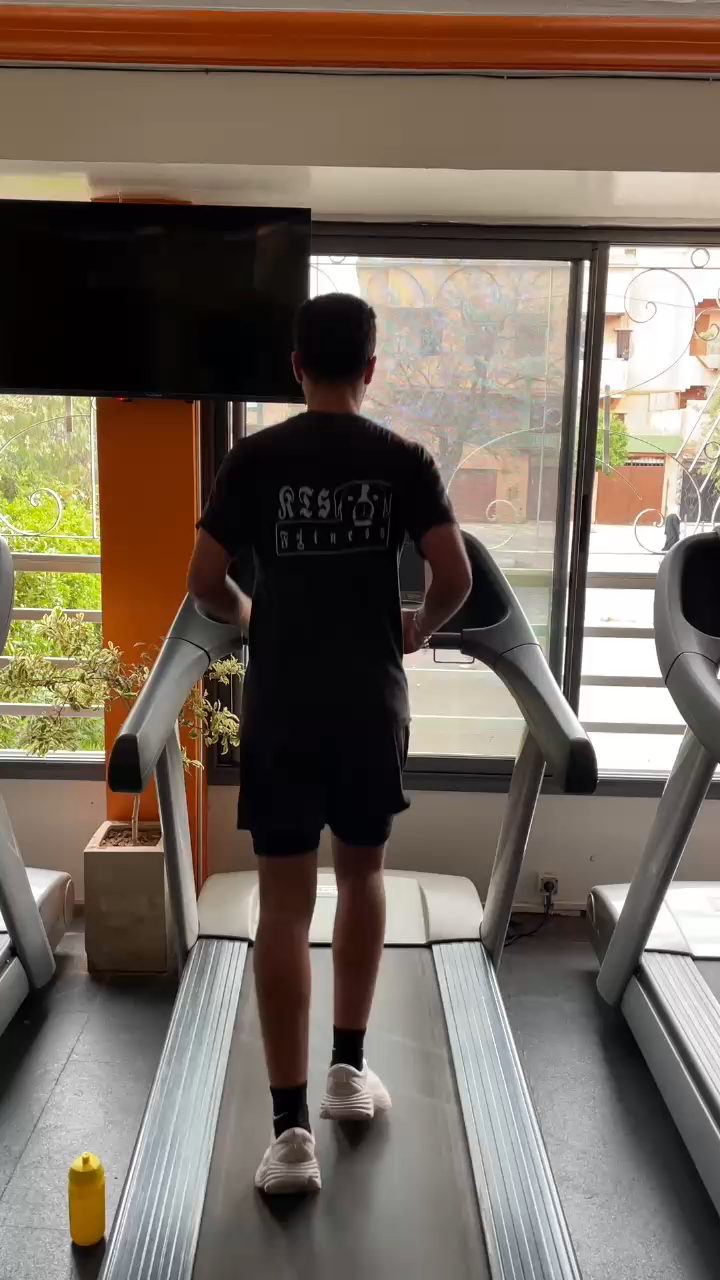
Run 247 · Recording conditions and entered information, not calculated results.
- Recording
- Rear-view running
- Surface
- Treadmill
- Body mass · entered
- 63 kg
- Height · entered
- 1.73 m
- Pace · entered
- 7:30 min/km
- Incline · entered
- 0%
01 · Movement estimates
Kinematics: tracking movement
Tracked body points describe how the legs move through the recording. Their positions allow angles and movement timing to be estimated in the camera view.
Step timing
Experimental video estimates. These values still need accuracy checks.
- Cadence
- 76 steps/min
- Left ground contact time
- 217 ms
- Right ground contact time
- 167 ms
Cadence is the number of steps per minute, counting both feet. Ground contact time is how long each foot stays on the ground during a step. The times above are averages estimated from tracked heel movement.
The tracking can miss steps or mistake when a foot touches or leaves the ground. These numbers do not yet establish the runner's true cadence or a left–right imbalance.
Estimated 2D camera-view geometry
Reading a knee angle
The hip–knee and knee–ankle lines meet at the knee. A straight line is 180°.
At 0.0 s: 178.5° left and 177.4° right.
These illustrate the calculation, not validated anatomical knee flexion. Accuracy depends on point placement and camera position.
02 · Segmentation demonstration
Body outline
Body segmentation separates the runner from the background. The silhouette helps inspect lateral movement, meaning side-to-side drift, and overall running form.
03 · Experimental 3D reconstruction
Estimating load on the body
The goal is to estimate how load is shared across the body during movement and highlight areas carrying more of it. This would help study how repeated loading relates to pain.
The red highlights currently show experimental model output. They do not measure tissue stress or identify where someone feels pain. Load estimates still need laboratory validation.
Research direction
Validation pathway
Kinematic accuracy
Compare corresponding movement measurements with synchronized marker-based motion capture. Compare 2D angles in the same camera plane.
Repeatability
Repeat recordings under consistent conditions and measure variation between trials.
Kinetic estimation
Evaluate ground reaction force estimates against force plates. Joint-moment validation also requires a defined biomechanical model and reference calculation.
The development direction is a repeatable workflow for reviewing trials, identifying tracking errors, and evaluating improvements against laboratory references.